

Marie-Renée Otis: le lancement du livre/book launch
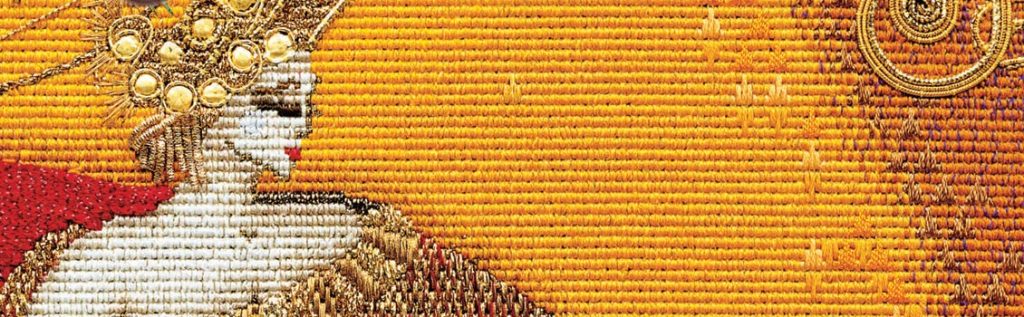
fourni par/submitted by Les Éditions Charlevoix C’est avec plaisir que nous annonçons le lancement du livre Abondance et Gratitude broderie d’art Marie-Renée Otis, édité par Les Éditions Charlevoix. Divisé en six chapitres, le livre se présente sous la forme d’une monographie, permettant de suivre le cheminement professionnel de l’artiste. Dans ses broderies faites à la main, Marie-Renée Otis renouvelle la technique de la tapisserie à l’aiguille en intégrant divers matériaux : des plumes, des perles, des bijoux, des fils métalliques et des éléments divers provenant de plusieurs pays. L’abondance des matériaux rares, des tissus somptueux, des fils d’or magnifiques, des perles nacrées sont au service d’un imaginaire bien personnel où les paysages de Charlevoix, au Québec, y jouent un rôle essentiel. Dans Abondance et Gratitude broderie d’art Marie-Renée Otis on peut lire « Les paysages de Charlevoix, montagne et fleuve Saint-Laurent, je les aime, je les marche, je m’en imprègne, je les dessine et je les brode. Assurément, ils influencent mon imaginaire : je brode des femmes-montagnes, des femmes-papillons, des femmes-marées. » Le livre de 200 pages, largement illustré, est écrit dans un style simple et accessible à tous. Il est offert dans la version anglaise ainsi que dans la version française. Au coût de 40. $ vous pouvez vous le procurer auprès de l’artiste marene2@hotmail.com We are delighted to announce the launch of the book Abundance and Gratitude: Art embroidery by Marie-Renée Otis, published by Les Éditions Charlevoix. Divided into six chapters, the book takes the form of a monograph, allowing readers to follow the artist’s professional path. In her hand-stitched embroideries, Marie-Renée Otis renews the technique of needlepoint tapestry by integrating various materials: feathers, pearls, jewels, metallic threads and miscellaneous elements from several countries. The abundance of rare materials, sumptuous fabrics, magnificent gold threads and pearly pearls serve a very personal imagination in which the landscapes of Charlevoix, Quebec, play an essential role in her embroideries. In Marie-Renée Otis’s “Abundance and Gratitude: Art embroidery”, we read: “I love the Charlevoix landscapes, the mountains and the St. Lawrence River; I walk them, I immerse myself in them, I draw them and I embroider them. They certainly influence my imagination: I embroider mountain-women, butterfly-women, tide-women.” The lavishly illustrated 200-page book is written in a simple, accessible style. It is available in both English and French. At a cost of $40, it is available from the artist marene2@hotmail.com
Instagram Identifier Inspiration
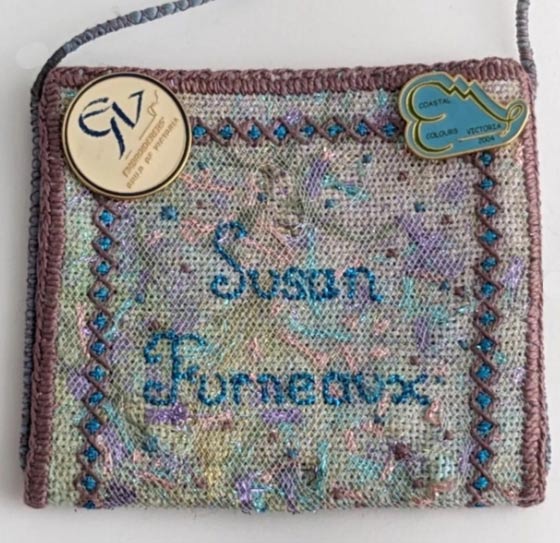
We all need them, we all make them! Let’s see yours! Share your name tag on Instagram. St. John’s Guild of Embroiderers is running an EAC/ACB members’ only contest on Instagram. No worries if you don’t have Instagram — you can just send images in an email to Susan Furneaux at susanfurneaux(insert the @ symbol in place of this statement)gmail.com. At the end of September, a small prize will be awarded to one entry drawn from all submissions received. Good luck! Susan is looking forward to hearing from you. If You Have an Instagram Account If you have Instagram, the Insta is @embroiderystjohns. You can load pictures on and tag @embroiderystjohns to enter. The hashtags for the nametags are #embroiderednametag and #handembroiderednametag. If You Don’t Have an Instagram Account Send an image of your nametag with your pins, bits, and bobs attached. Include who designed it, its technique and how old it is. You can also add any anecdotes you like! Have more than one nametag? Enter twice or three times if you are that organized. Other than your first name and the info above, you will only be mentioned if you want to be tagged. If so, send along your Instagram account.
My Blue Table Runner
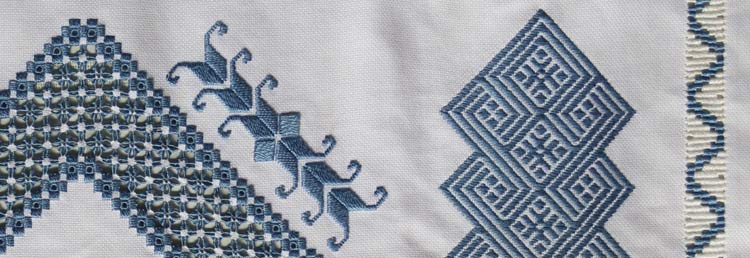
by Nancy Tozer, Lakeshore Creative Stitchery Guild/La Guilde des travaux à l’aiguille du Lakeshore, Virtual Threads, and Ottawa Valley Guild of Stitchery I joined the Lakeshore Creative Stitchery Guild/La Guilde des travaux à l’aiguille du Lakeshore when I was still working full time. Regular meetings and classes took place weekly on Thursdays; there were no evening stitching groups at the time. So, I decided to enroll in EAC/ACB’s Basic Counted Thread correspondence course. The final project in lesson six was to stitch a sampler on evenweave fabric. The sampler was to include a hemstitched border, mitred corners, and two of the four techniques covered in the course. I chose pattern darning and Hardanger. I used several Ukrainian embroidery books as sources of inspiration, instruction, and reference. I embroidered the table runner in blue thread on white fabric to complement my home décor. I chose DMC 334 because it was available in floss, pearl cotton #5, and pearl cotton #8. I used the floss for the pattern darning motifs and the pearl cotton for the Hardanger section and needle woven border. Inspiration for my design started with the pattern darning motif. I found the motif on the sleeve of a Ukrainian blouse and immediately knew that I wanted to stitch this. I embroidered the design using the Ukrainian technique perevolikania and six strands of DMC floss. The central design illustrates the Hardanger technique. It consists of a medallion surrounded by a band of Greek crosses (a woven filling stitch used in Hardanger embroidery) and satin stitch motifs. Hardanger satin stitching is similar to the Ukrainian lyshtva stitching technique. The Greek cross band was inspired by designs in Janice Love’s Hardanger: Fundamentals Made Fancy. I mitred the corners and hemmed the edges using antique hemstitch, called prutyk in Ukrainian embroidery. The needle weaving pattern was inspired by the border on a Schwalm pillow. It consists of half diamonds in white separated by a step pattern in blue. I stitched this using the Ukrainian technique of latana merezhka. My table runner turned out to be a very large, ambitious project, taking me four months to complete. Fortunately, my course counsellor, Colleen Darling, was very understanding as my last lesson was quite delayed in being sent to her for evaluation. As I was designing and stitching this piece, I found it very interesting to note the similarities between Ukrainian stitching techniques with those found in other countries. It seems that the art of embroidery knows no boundaries, with designs and techniques shared amongst needleworkers the world over. My blue table runner won the “Best of Class” award in the Hardanger, Lace, Pulled and Drawn Thread – Original Design category at Seminar 2000 in Moncton, New Brunswick.
Memories
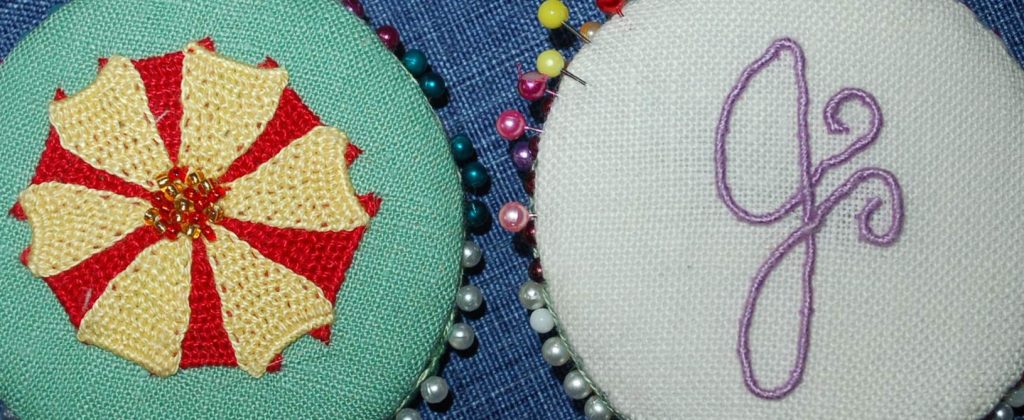
by Odette Gaudet, Chickadee Chapter of Needle Arts “Memory” is defined as the power of remembering; the time during which past things can be remembered; that which is remembered (Highroads Dictionary, 1963). “Remember” is defined as to call to mind; to keep in mind; to use the power of memory; to recollect. Most often, we think memories are only of the past, something that happened long ago. Memories can have a place in the present and future. Chickadee Chapter of Needle Arts had two active members pass away. Susan Pickett at age 65 in November 2013, and Helen Crawford at age 88 in June 2015. As a small guild, this was extremely sad and hard as both women played a strong role in our group. Susan Pickett loved Hardanger. She stitched incredibly beautiful pieces. Her legacy project of stitching a piece for each family member at her passing was incomplete. Guild members finished the remainder. What we learned has been invaluable. Sue liked to change one thing. She would change one colour, for example, white thread on red fabric or blue thread on white fabric. The results were always stunning. She would also change the size or shape. If the piece were square, she’d make it a rectangle. Changing one or two elements can completely alter the look of a project. It’s a great lesson going forward and applies to other projects and life. Helen Crawford loved to stitch. She especially loved cross stitch and mill fabric from Humphrey Textiles, a textile mill in Moncton. The mill plant made fabric of 18-count that was most often used on cubicle wall dividers. When Helen was younger, she could buy a large bag of remnants for five dollars. She stitched everything on this fabric. She made one of everything for each member of her family – pillows, afghans, placemats, wall hangings, bell pulls, coasters, table runners, and ornaments. Anything you can imagine until family members said, “Stitch for yourself, we have enough.” The year before her death, Helen talked about framing the stitched pieces she had finished. I volunteered to help her complete this project. Unfortunately, Helen passed away before we could finish this. Her stash was then passed to her sister, whom I met at the funeral, and we became friends. At the end of 2016, I helped Helen’s sister frame the finished pieces. She then gave one to each of their family members. Even though the family, years before, said, “enough,” being surprised with a final piece by Helen was emotional and meant a great deal as no more will ever be made. Helen’s lesson on stitching is a strong message. You do it because you love it. We put ourselves into what we do, and what we do feeds our souls. Why not fill it with love for those around us and ourselves? In both Susan’s and Helen’s cases, much of their stash was given to our chapter. We sorted through the patterns for future programs. Raw materials were saved for the same purpose. We hosted a tea party in their honour and a stash share, where guild members could come and take any part of the stash home to enjoy. Any remainder was sent to another guild. As part of the Chickadee Chapter of Needle Arts program, we have hosted several projects in their memory. We made Casalguidi pin keeps with Susan’s green fabric. We made flowers on one side and our initials on the other. Susan had white linen that we used to stitch a Schwalm needle case designed by José Hope. We were also able to host an afghan class from Helen’s stash. Our 2021 summer challenge was “hosted” by Helen, making a household item from her fabric supply, using a variety of patterns supplied. Memories are funny. When we miss our friends and family we are often filled with sadness and grief. If we only focus on these thoughts and feelings, we are left in a void of misery. Other times memories give us comfort and joy. Choose what you’ll feel, by choosing where your focus goes. Choose love, fun, and happiness, for yourself. Having stitched pieces with fabric from Susan and Helen is a way to keep them and their memories close. They haven’t really left us. The lessons they taught us and the example they lived are with us. I can hear them when I’m starting a new project. Do I love it? Will I learn something? Can I change one thing that will make it “me”? Most importantly, love what I do and those around me. Life is a full experience waiting for us to embrace. How will you embrace it today?
A Tribute: Jo Hewitt-Nickel (1927-2022)
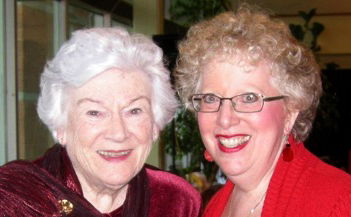
This lovely tribute to Jo Hewitt-Nickel was written by Patty Hawkins, a member of the Winnipeg Embroiderers’ Guild. I am very sad to share the news with Winnipeg Embroiderers’ Guild members that Jo Hewitt-Nickel passed away on Thursday, December 8, at 95. Others in the guild knew Jo better than me, but no one could have been fonder of her. For our newer members who did not have the privilege of being acquainted with Jo, let me tell you a little bit about her. Jo was a founding member of both WEG and the Embroiderers’ Association of Canada/Association canadienne de broderie. That means she has been involved with our organizations since 1973 and was the last surviving founding member. She was active in our guild and always interested in all things “needlework.” She was a retired art teacher (Balmoral Hall) and created beautiful artwork of all kinds, including embroidery. I met Jo when I joined WEG in 2004. In her mid-seventies at the time, she attended WEG meetings regularly. She was a true “presence” – beautifully turned out, surrounded by members wanting to visit with her, and always happy to catch up with your news. She was especially generous with needlework advice and mentored many of us in our embroidery journeys. Jo also taught workshops for WEG. I was delighted to create two of her beautiful “angels.” The first, a larger angel that could be used as a Christmas tree topper or ornament I named, of course, “Jo.” This was my introduction to stitching on trigger cloth. The technique we used can loosely be called crewel work, but Jo gave us no specific directions. Instead, she encouraged us to “run with it” and try new things. I am no designer, but I am delighted with the freedom she inspired in me, and I love how my “Jo” turned out. I appropriately named the second smaller angel, also stitched on trigger cloth, “Margaret” (Jo’s official given name). This was my first foray into actual crewel work. Jo consulted with each of her students, demonstrated a variety of stitches, and taught us about colour and stitch execution. Once I finished both of my angels on my own, Jo painted beautiful faces on them. Even as I type this, “Jo” and “Margaret” grace my living room – beautiful Christmas decorations with such poignant meaning for me – especially now. I visited Jo at her apartment at the Canoe Club on a couple of occasions. When she moved over to the assisted living side, she treated Don and me to lunch, and I visited her a number of times in her lovely unit. We talked for hours about everything: her family, beloved grandchildren, movies, needlework, her life, my life – you get the idea. She even hosted my in-laws when they were contemplating a move to the Canoe Club; she showed them around her place and the space in general. Don and I were delighted to host Jo at our house for brunch on one unforgettable occasion. Jo was recognized as a Founding Member of EAC/ACB at the 40th-Anniversary Seminar in Winnipeg in 2013 and again at the Founders’ Tea held by WEG on October 13, 2019. At that event, many of us were thrilled to honour Jo and another surviving founding member Shirley Tyderkie, delighted to meet their families, and take in a display of their beautiful needlework. A few years ago, Jo moved from independent living to the home of her son Gary and his wife Helga, where she could be better cared for. I only spoke to her briefly once though I often thought of her and reminded myself, “I should call her.” I regret now that I didn’t. But what a privilege it was to have known this special lady. She spoke with a lilting Irish accent, was always interesting and curious, and literally twinkled with joy and good humour. I hope all of you who knew her will keep her in your hearts, and for those who are meeting her for the first time through these words, may you always know that there are extraordinary people in this world. Jo was one of those rare few.
The Edmonton Needlecraft Guild’s Virtual Spring Fling: A Delightful Way to Spend a Weekend!
Hear about ENG’s Virtual Spring Fling from Patty Hawkins
Issue 33 of Giuliana Ricama

submitted by Joyce Gill I was really pleased when I heard that Giuliana Ricama was going to be produced in English. I have several past issues in Italian that I love to browse. The projects are inspirational, and I feel that I could accomplish some of them using the diagrams, even though I do not know the language. Issue 33 in English does not disappoint. The millefiori flowers are exquisite. The Springtime Easter Eggs are really lovely. The Reticella project opens up new worlds to me. So far, I’ve only browsed and dreamed, but I know that one of these three will be on my to-do list very soon. Italy is halfway around the world from my home in Atlantic Canada, but the magazine is a doorway to the artistry of a new fellowship of needleworkers.