

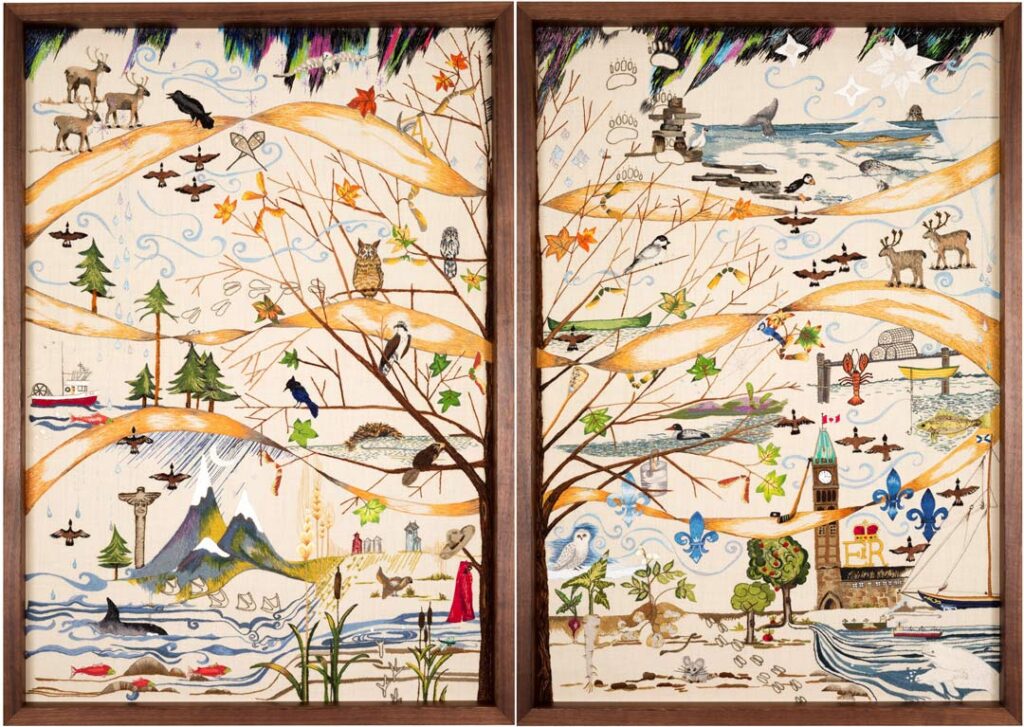
The Canadian Embroidery Tapestry was first conceived in May 2014 during a tour of Rideau Hall when the Ottawa Valley Guild of Stitchery was hosting the EAC/ACB seminar.
As the tour group wound its way through the official residence of the Canadian monarch and their representative, the Governor General of Canada, it was noted that there were paintings and sculptures everywhere, but no textile arts on display. It was decided that day in Ottawa that a textile project would be created by the members of EAC/ACB to address that omission and to celebrate Canada’s upcoming 150th birthday in 2017.
Helen McCrindle was asked to take the lead on the project by then-president Beryl Burnett. Helen agreed and asked three other women – Catherine Nicholls, Bonnie Adie, and Pat Ross – to assist with the massive venture.
Before the first stitch was placed, hours and hours of planning went into the project. Numerous meetings were held as Catherine worked on the design, and samples were stitched to see how specific details would look.
The fabric used in the project is sturdy linen twill, and the threads are a combination of Appletons crewel wool for the larger stitched areas, DMC cotton floss for details, and metallic threads for highlights. By the time the design was finalized, there were 118 different colours of Appletons and 133 colours of DMC for the two 2’ x 3’ (60 cm x 90 cm) panels. DMC (US headquarters) kindly donated two skeins of each thread, while Helen supplied the Appletons wool.
The outlines of the symbols, buildings, flora, and fauna were transferred to the fabric using Saral transfer paper. Then, archival pens were used to make the lines permanent. The project was divided into 24 six-inch (15 cm) squares with the corresponding collection of threads stored in little clear bags.
Detailed instructions were also created with rules such as no knots, two strands of DMC (unless specified), and one of crewel. Most importantly of all was the rule to follow the coloured images.
The fabric was next attached to roller frames, which allowed up to two stitchers to work on the project at once.
The East panel began its cross-Canada odyssey in Truro, Nova Scotia and the West panel debuted at the 2015 seminar in Calgary, where it was then taken to its first chapter, the Vancouver Guild of Embroiderers. The first two people to place stitches were Beryl Burnett and Amanda Baxter, co-chair of Seminar 2015. The two panels were reunited at Seminar 2016 in Toronto, and then switched paths, with the East panel crossing the Prairies to the west coast, while the West panel travelled across Ontario and Quebec to the Atlantic provinces.
The panels were worked on in members’ homes, with other members invited to come stitch at chapter locations and other places, which varied from churches and shops to folk festivals.
With the panels travelled logbooks, where stitchers wrote down their thoughts and reactions to working on the project. The panels, with accompanying materials and paperwork, were either shipped in their respective special 4’ x 2’ x 2’ (120 x 60 x 60 cm) boxes from chapter to chapter or sometimes transported by members to their new temporary home if possible.
Throughout the process, Helen and her team kept track of the locations of the two panels at all times and the National Capital Commission, the steward of Rideau Hall, was updated with the progress of the panels.
Some of the Canadian Embroidery Tapestry Symbols
The project features a maple tree at its centre. The tree is shown through the four seasons with spring buds and a bucket to capture maple sap, summer foliage, its dying leaves in autumn, and barren branches for winter.
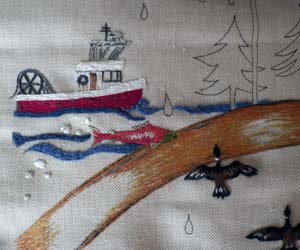
The three golden ribbons represent the Trans-Canada Highway, the Trans-Canada Railway, and the Trans-Canada Trail (formerly known as the Great Trail from September 2016 to June 2021).
- Great Horned Owl (Bubo virginianus) for Alberta
- Steller’s Jay (Cyanocitta stelleri) for British Columbia
- Great Gray Owl (Strix nebulosa) for Manitoba
- Black-Capped Chickadee (Poecile atricapillus) for New Brunswick
- Atlantic Puffin (Fratercula arctica) for Newfoundland and Labrador
- Gyrfalcon (Falco rusticolus) for the Northwest Territories
- Osprey (Pandion haliaetus) for Nova Scotia
- Rock Ptarmigan (Lagopus muta) for Nunavut
- Common Loon (Gavia immer) for Ontario
- Blue Jay (Cyanocitta cristata) for Prince Edward Island
- Snowy Owl (Bubo scandiaca) for Quebec
- Sharp-Tailed Grouse (Tympanuchus phasianellus) for Saskatchewan
- Common Raven (Corvus corax) for the Yukon Territory
This article was written by Victoria Moorshead and originally appeared in the Fall 2021 issue of Embroidery Canada.
Update: May 2020
The past year brought about a sense of completion for this project that we started to celebrate and recognize Canada’s 150th anniversary as a country. All embroidery was finished by the end of 2018. The linen fabric was cleaned, stretched and framed in early 2019. In the fall of 2019, the Government of Canada arranged to ship the pieces to Ottawa, where they were held until they were put in place.
The two Canadian Embroidery Tapestry panels were put on display just as the COVID-19 pandemic lockdown came into effect in March 2020.
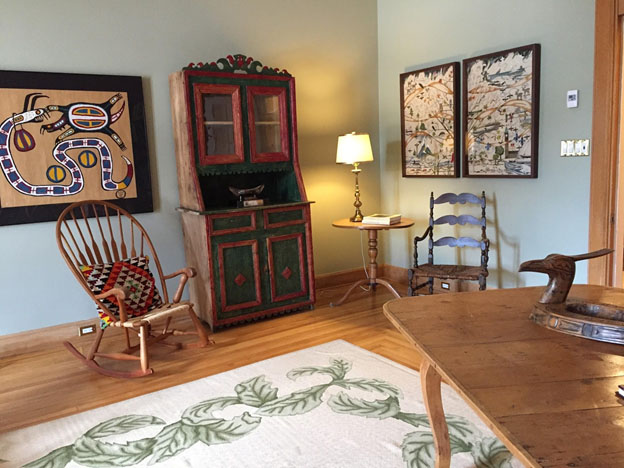
The embroidery has been assigned and hung in Rideau Hall in the Pauline Vanier room, which is one of the most important interiors in Rideau Hall, where a broad representation of furnishings and artwork from across the country can be appreciated.
Update: October 25, 2019
The two carefully packed panels were shipped to Ottawa on October 25, 2019. We are waiting to hear where they will be displayed and will let everyone know as soon as we do!
The project that we have called Project 150 for the past few years has a new name. In early May 2019, the project lead, Helen McCrindle, received word that the Canadian Embroidery Tapestry had been officially accepted into the Government of Canada’s Crown Collection.
More than 650 Canadians of all ages and origins stitched on the project, and more than 8,000 hours of work were recorded.
You can read more in the July 6, 2019, article published by the North Shore News from Vancouver, BC.
Address to Seminar 2017, St. John’s, NL – May 2017
Helen McCrindle: Project 150 Team Leader
In May of 2014 – three years ago, the seminar was held in Ottawa. Some members took a tour of Rideau Hall, home of the Governor-General of Canada. They were disappointed to discover that there was no textile art in the collection of Rideau Hall. The people on the bus tour had an idea to produce an embroidered piece of art to celebrate Canada’s upcoming sesquicentennial.
I was approached that summer by the then-president, Beryl Burnett, to ask if I would become the team leader. I thought about it for a few days and took stock of the possible local textile artists that I could call on to be part of my team. I invited three people to be committed to the project. Catherine Nicholls, Bonnie Adie and Pat Ross met with me to brainstorm what would be included in our tribute to Canada.
These meetings were held frequently to nail down what we wanted, and finally, Catherine Nicholls, a textile artist from North Vancouver, agreed to be the designer. She spent three long months on the design, which is divided into two panels because the woodwork on the walls in Rideau Hall is divided into 2-3 3-foot strips.
Once the design was completed in black and white, Catherine started the colouring of the images. Meanwhile, it was decided to use sturdy linen twill for the fabric as it is strong enough to receive all the different threads.
We decided on a mixture of DMC cotton floss for detail and Appleton Crewel wool.
There were many meetings with Catherine to determine the exact colours of both threads. In the end, there were 133 different colours of DMC cotton thread. DMC headquarters in the US agreed to donate two skeins of each thread. I supplied the Appleton wool threads of which there were 118 different colours. Metallic threads were also gathered for special effects.
We transferred the design to the cloth using Saral transfer paper. It is not permanent, so we had to go over every line with archival pens to make the images permanent.
Once the design was on the fabric, we turned our attention to dividing up the design for embroidery. We divided each panel into a 6” square grid – 24 squares on each panel. We selected all the threads needed for each 6” square and stored the threads in small plastic bags.
All the while, we were sampling many of the elements to see what the effects would be. Extensive directions were written for each of the squares.
Basic rules were established. No knots, two strands of cotton thread unless specified otherwise. One strand of crewel wool. Most important: Follow the coloured images.
The Western panel was started in Winnipeg, and the Eastern panel in Truro, Nova Scotia. The panels were sent with their accompanying frames to the many guilds in the east and west, and then at the end of 2015, the panels switched from east to west and west to east.
The panels have been worked on at festivals, like Folklorama in Winnipeg and in needlework store windows and even in grocery stores.
Our goal was to have the panels completed by December 2016, but that did not happen, so as of February of this year, the panels have been in the Vancouver area and are currently in my studi,o where members of the
Vancouver Guild and the North Shore Needle Arts have been working on them.
Thousands of hours have been spent designing and writing directions and actually embroidering the designs. At each stop, the logbooks have been signed by our members with their comments.
- Who knew that the mighty maple tree provided the wood for the early lacrosse sticks? (Find it on the Eastern panel.)
- Who can identify all of the provincial and territorial birds that are perched on the maple tree’s branches?
- Who knew that the helicopters or seed pods of the maple tree are called ‘samaras’?
- Did you discover that there are three golden ribbons that twist through both panels, representing the Trans Canada Highway, the Trans Canada Railway and the Trans Canada Trail?
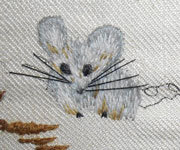
- Notice that there are bird and animal tracks that appear on the panels – moose tracks, Canada goose tracks, great blue heron tracks and polar bear tracks.
- Did you know that the wispy bits at the tip of the wheat plant are called ‘awns’?
I have been struck by some of the comments in the logbooks, left by stitchers who have worked on the panels:
“We have enjoyed our time together, stitching on Project 150. It has brought our guild closer together. We are all looking forward to the unveil and seeing it hang in Ottawa.”
“Congratulations to our designer – what an epic way to represent Canada!”
“What a privilege to stitch on such a national project. It brings us all together.”
This comment was written on Remembrance Day. “It was poignant working on this today – what it means to be Canadian and to have the freedoms with our natural resources and our lives. Thank you for this opportunity.”
“Everyone who came to my house to stitch was apprehensive at first, but then enjoyed the process and were glad they had participated.”
“From coast to coast – people sharing a passion for the threaded needle!”
All the way along, I have been in contact with the National Capital Commission, which oversees the acquisitions of objects for the various venues in Ottawa. They wish to wait until the project is complete with cleaning, blocking, mounting, and photographing done before they make a decision on the project. As of this time at the seminar in St. John’s, I estimate another 200 to 300 hours of embroidery left to complete the project.
I want to thank all members, young and not so young, who have spent some time translating the vision of the artist, Catherine Nicholls, into a Canadian tapestry of celebration!
Happy Birthday, Canada!
A Project Update from Helen McCrindle
February 2016
One year ago, my Vancouver team was putting together the many packages of threads and wools that would be needed to embroider the two panels of the project that would celebrate Canada’s entry into Confederation in 1867. Last May, the Committee launched the project in Calgary at Seminar 2015, and ever since then, the two panels, one in the East and one in the West, have been circulating around the many guilds of our organization.
Hundreds of hours were spent designing, colouring, transferring the design and writing directions for the creation of this project.
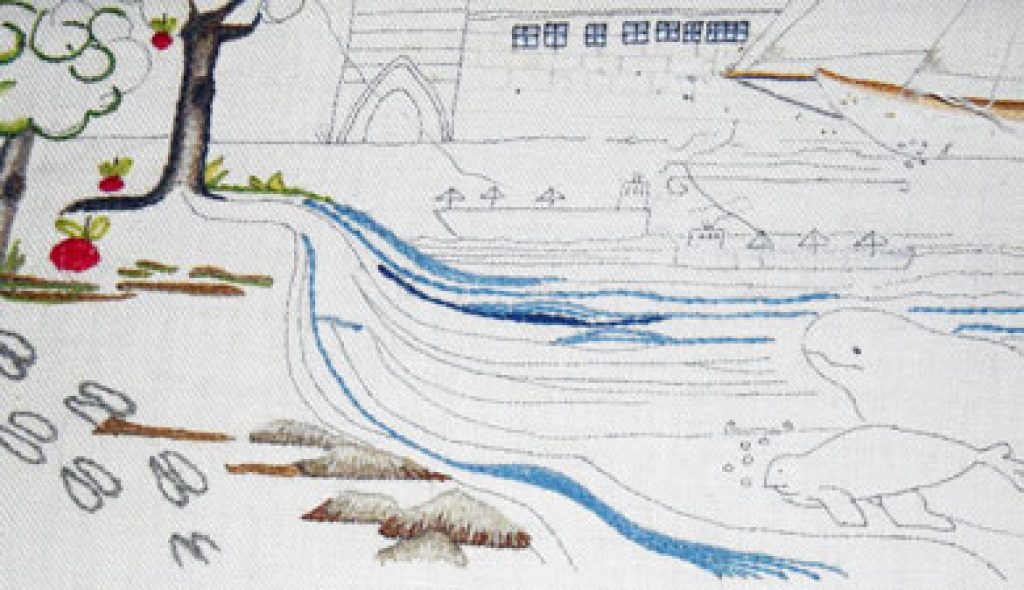
The panels have gone through four seasons of the year. The summer was spent in Vancouver looking out over floral gardens, in the Maritimes looking out over seascapes. Fall brought stitchers to Vancouver Island and Eastern stitchers in Ontario. Winter came with a vengeance to the embroiderers in Ottawa and Quebec, and western stitchers in Alberta and Manitoba. Through it all, the panels have travelled in all weather conditions! The spring now entices the Fraser Valley embroiderers and Regina and Edmonton to put in their embroidery stitches in the West, and Montreal and St. John’s in the East.
Now, we look forward to Seminar 2016 in Toronto at Humber College, where the two embroidered panels will meet for the first time. Seminar participants will be able to spend time stitching on them. After the seminar, the Eastern Panel will go West and the Western Panel will travel to the East of Canada.
I want to thank all members, young and not so young, who have spent some time translating the vision of the artist, Catherine Nicholls, into a tapestry of what it means to be Canada into stitch. May we continue throughout 2016 to complete the work. We hope to present the finished panels to the Government of Canada after our Seminar in 2017 in St. John’s, Newfoundland.
I look forward to the finished embroidery!